“Francesca Cabrini: A Saint Tested by Time”
Di Noha Iraqi
Introduction
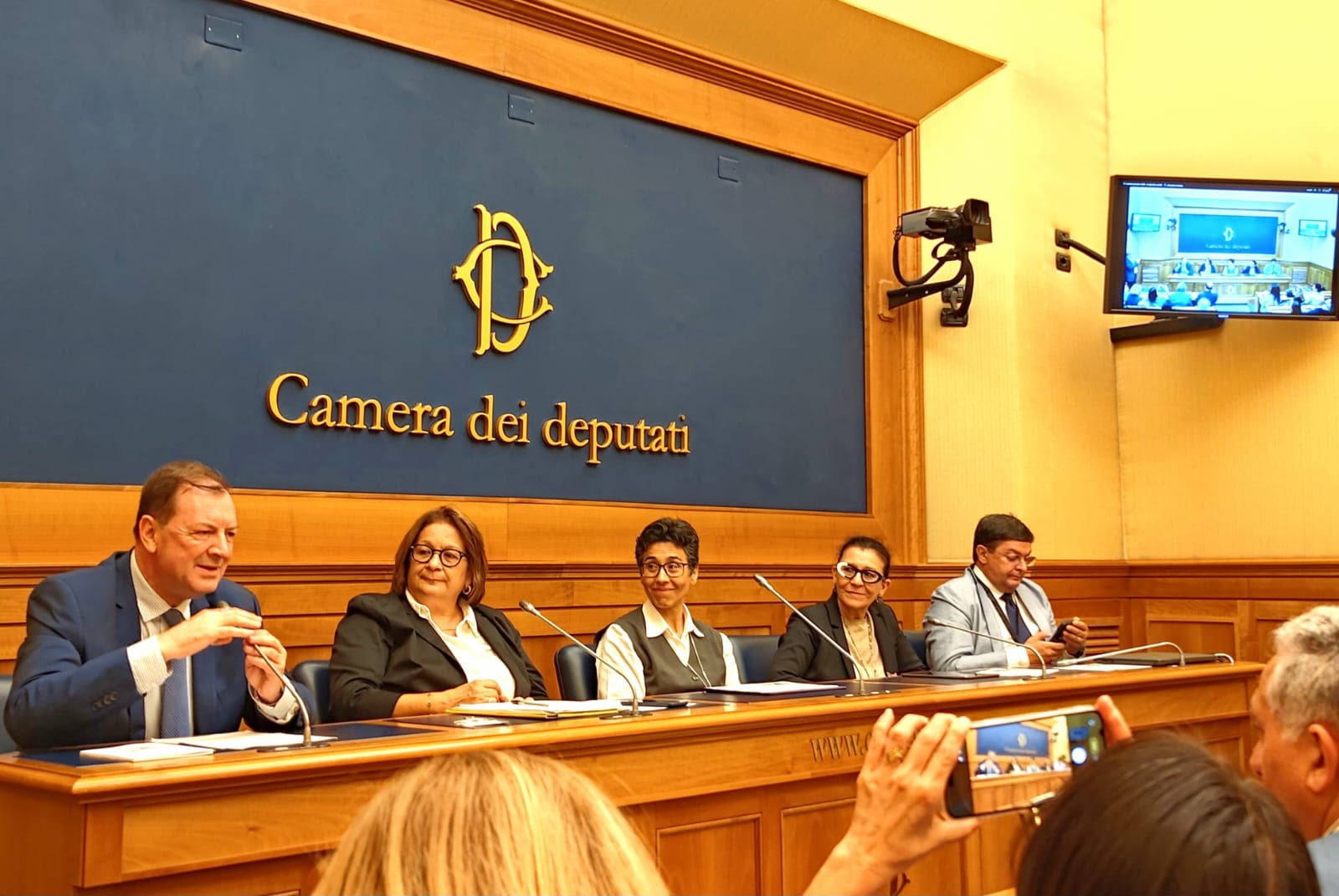
On July 21, 2026, Italy’s Chamber of Deputies hosted the presentation of Gianni Lattanzio’s new book, “Francesca Cabrini: A Saint Tested by Time,” marking the 80th anniversary of the canonization of Saint Frances Xavier Cabrini, the “Angel of Migrants.” Cabrini arrived in New York in 1889 to assist Italian immigrants living in poverty and facing prejudice, and despite poor health, she crossed the Atlantic repeatedly, establishing 67 schools, hospitals and orphanages across the United States, Nicaragua, Argentina and Brazil before becoming a naturalized U.S. citizen in 1909. Lattanzio’s book places this American chapter of her life at the center of the narrative, reading her legacy as a lens through which to understand today’s migration debates and the new inequalities produced by technological change. We spoke with the author about why the Americas remain the true heart of the Cabrini story.
Interview with Gianni Lattanzio
Q: Mr. Lattanzio, your book gives enormous weight to Cabrini’s American years. Why did you choose the Americas as the true center of gravity of her story?
A: Because that is where she becomes the figure we recognize today. Her mission changes direction on the explicit request of Pope Leo XIII, who told her “to the West, not to the East.” Guided also by Bishop Giovanni Battista Scalabrini, a deep expert on Italian migration, she sails for New York in 1889 with a small group of sisters. The Atlantic is not simply a backdrop in the book — it is the space where her charism turns into method, institution, and a concrete answer to one of the great transformations of the modern age: mass human mobility.

Q: What exactly did Cabrini find when she landed in New York?
A: She found Italian immigrants living in extreme poverty and facing open prejudice, crowded into degraded neighborhoods, seen mainly as cheap labor rather than as people. Her answer was never purely charitable in the sentimental sense. She built schools, orphanages, and hospitals — including the well-known Columbus Hospital in New York — turning scattered acts of compassion into a genuine system of care.
Q: Beyond the United States, where else in the Americas did she work?
A: This is something readers often don’t realize. Cabrini’s American mission was not limited to New York or Chicago. She traveled extensively through Nicaragua, Argentina and Brazil, founding schools, orphanages and hospitals wherever Italian communities had settled. By the time of her death in Chicago in 1917, her congregation had established 67 institutions worldwide, run by roughly a thousand sisters. It was a hemispheric project, not a local charity.
Q: Your book insists that Cabrini gave “dignity to Italian Americans.” What do you mean exactly?
A: Italian immigrants in the Americas suffered not only material poverty but also social contempt, ethnic suspicion and cultural insecurity. Cabrini worked precisely on that symbolic level. Her schools and hospitals were places where migrants could be recognized — and recognize themselves — as capable of study, work, faith and civic growth. It was a form of collective re-narration, restoring voice and future to a stigmatized community.
Q: How does this connect to today’s migration debates in the Americas and beyond?
A: Recent commemorations at the Chamber of Deputies underlined exactly this point: welcoming migrants, serving vulnerable people, and defending human dignity are not partisan positions — they are shared moral responsibilities. Cabrini’s American experience shows that integration is not automatic; it requires institutions, patience and organized solidarity, something equally true for migration flows across the Americas today.
Q: Your book also draws a parallel between Cabrini’s era and today’s digital transformation. How do the two connect?
A: If Cabrini found migrants excluded because of language, missing documents, or poverty, we should ask what the new “ports of arrival” for exclusion look like today. I believe one of the most important is digital. Artificial intelligence and new technologies can be, like the Atlantic once was for Italian immigrants, a path toward opportunity — or they can create a new kind of “poor neighborhood”: people with no access to technology, or discriminated against by poorly designed automated systems.
Q: What lesson would you draw from Cabrini’s American mission for facing this new digital poverty?
A: That no great transformation — neither transatlantic migration in her time, nor the digital revolution in ours — can be left without institutional accompaniment. Cabrini did not simply pity migrants; she built schools so their children could study, hospitals so they could be cared for, and she insisted they learn the laws and their rights. Today we need the same kind of institutional commitment to make sure artificial intelligence does not become a new frontier of inequality.
Q: A final message for readers, particularly those connected to Italian communities across the Americas?
A: I hope this book travels well beyond Italy, reaching Italian American communities, schools and associations throughout the Americas. Cabrini’s story reminds us that the history of Italian emigration is not only one of suffering, but also of the capacity to build, with dignity and organization, a better future — a legacy that belongs to all Italians in the Americas, and one worth telling again today.